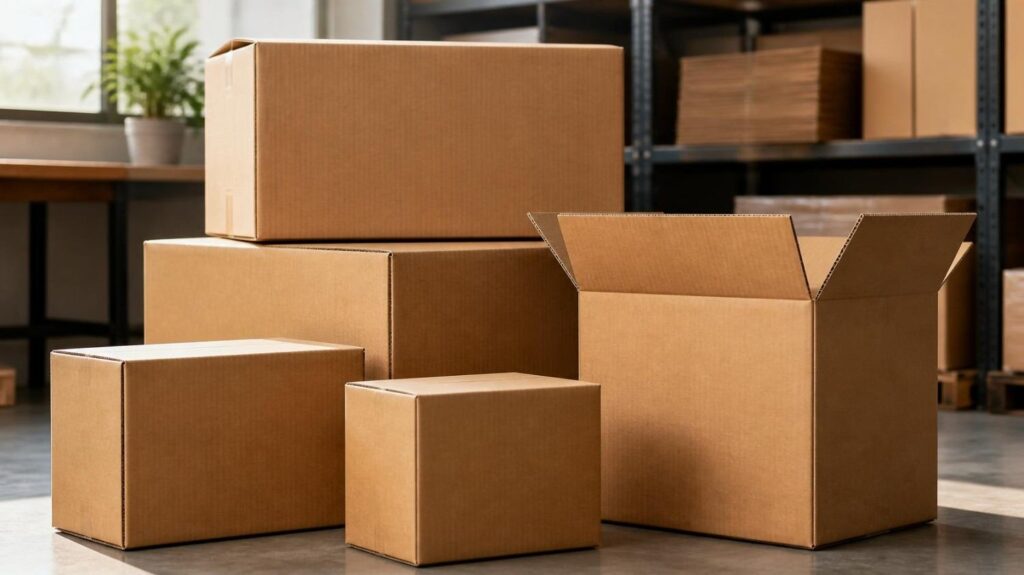
Corrugated cardboard boxes are the workhorse of modern packaging. They carry online orders to customers’ doors, move products between factories and warehouses, hold fresh food and bottled drinks, and protect fragile electronics on long routes. Few materials combine strength, low weight, low cost, and customization as well.
But what makes corrugated different from ordinary cardboard, and which box type fits which job? This guide covers what corrugated boxes are, how they are made, the nine most common uses, and how to choose the right box by wall type, flute, style, and strength rating.
| Quick Answer: Corrugated cardboard boxes are used to ship, store, protect, and present products. Their fluted middle layer adds strength and cushioning while keeping weight low, which makes them ideal for e-commerce, food and beverage, retail, electronics, industrial parts, apparel, healthcare products, and moving and storage. |
What Are Corrugated Cardboard Boxes?
Corrugated cardboard boxes are containers made from corrugated fiberboard: a fluted (wavy) paper layer glued between one or more flat liner sheets. The flutes form small air channels that add rigidity and cushioning, so the board resists compression, impact, and bending while staying light.
A basic corrugated board has three components:
- Outer liner: the exterior paper layer that gives structure and a surface for printing.
- Fluted medium: the wavy middle layer that absorbs impact and adds stacking strength.
- Inner liner: the interior layer that supports the flutes and protects the product.
Cardboard vs. Corrugated Cardboard
Cardboard is a catch-all word for heavy paper products, including flat paperboard used for cereal boxes and folding cartons. Corrugated cardboard, more accurately called corrugated fiberboard, is specifically the fluted, layered material used for shipping boxes. It is significantly stronger and more protective than flat paperboard.
How Are Corrugated Boxes Made?
- Corrugating: a machine called a corrugator heats and shapes the medium paper into flutes.
- Bonding: adhesive joins the fluted medium to the linerboard, forming a single-wall board. Additional layers create double-wall or triple-wall boards.
- Converting: the sheets are cut, scored, printed, folded, and glued or stitched into finished boxes.
- Finishing: boxes may receive custom printing, coatings, die-cut features, or inserts depending on the application.
The board grade, flute, and wall construction are chosen to match the product weight and the conditions it will face in transit and storage.
Common Uses of Corrugated Cardboard Boxes
Corrugated packaging appears in nearly every supply chain. Here are the nine most common applications.
1. E-Commerce Shipping
Online retailers depend on corrugated boxes to move orders from fulfillment centers to customers. A parcel may be picked, sorted, loaded, and unloaded many times, so the box must resist crushing, punctures, and shifting.
Right-sizing the box to the product reduces void fill, lowers dimensional-weight shipping charges, and improves the unboxing experience. Learn more about custom shipping boxes built for online orders.
2. Product Shipping and Distribution
Manufacturers and distributors use corrugated cartons to move goods to retailers and customers. The boxes stack efficiently on pallets and in trucks, and they can be combined with dividers, inserts, and cushioning for added protection.
3. Food and Beverage Packaging
Corrugated is used throughout the food supply chain for packaged foods, bakery items, bottled beverages, and produce. Requirements vary: moisture-prone or refrigerated products may need wax-alternative coatings or moisture-resistant board, and any material touching food directly must meet food-contact standards.
4. Retail Product Packaging
Printed corrugated boxes protect products on the shelf and sell them too. Logos, graphics, and product details can be printed directly on the board, and thinner flutes such as E and F give a smooth surface for high-quality graphics. Explore custom printed boxes for retail.
5. Electronics Packaging
Electronics need snug fits and impact protection. Corrugated boxes paired with custom inserts, partitions, or foam limit movement and shield sensitive components from shock and static-generating friction. Box dimensions should match the product’s size, weight, and fragility.
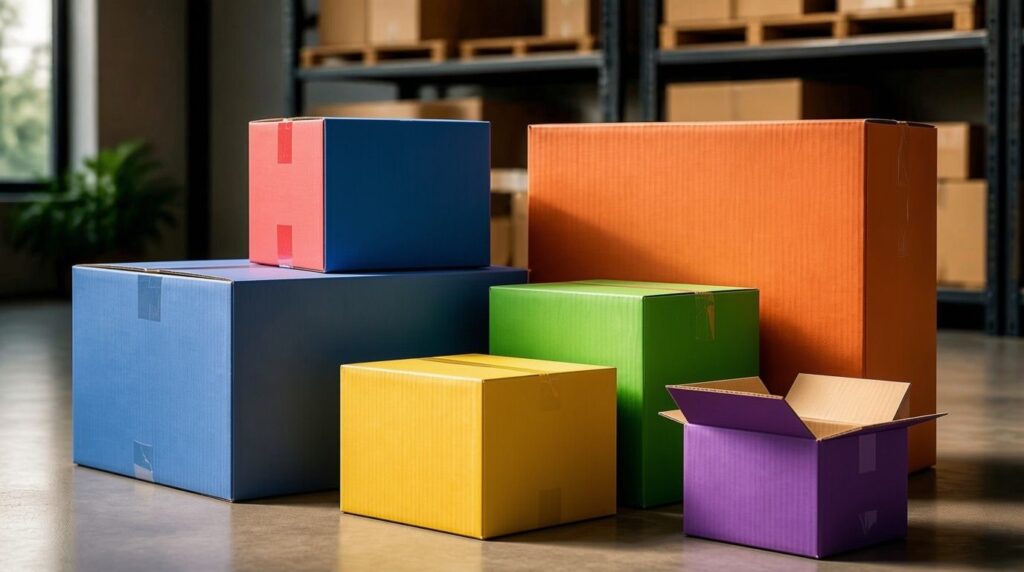
6. Industrial and Automotive Parts
Tools, fasteners, replacement parts, and components are often heavy and irregular. Double-wall or heavy-duty board, plus dividers that separate parts, keeps shipments intact and makes inventory picking easier.
7. Apparel and Fashion
Clothing, footwear, and accessories ship in corrugated mailers and shipping boxes. For fashion brands, the box is part of the brand experience, so custom printing and inserts help create a consistent look from label to unboxing. See our mailer boxes.
8. Cosmetics, Personal Care, and Healthcare Products
Corrugated shipper boxes protect glass bottles, tubes, and jars during distribution, while printed E-flute cartons make attractive retail packaging. Healthcare and pharmaceutical shipments use corrugated outer cartons for bulk transport, often alongside tamper-evident and temperature-control measures set by the product’s requirements.
9. Moving, Storage, and Warehouse Organization
Corrugated boxes are the standard for household moves, office relocations, archive storage, and warehouse bins. Their stackable shape makes them easy to label and organize, and heavier loads call for stronger board or smaller box sizes to avoid failure when lifting.
| Need boxes built for your product? We design and produce custom corrugated boxes in the size, strength, and print style your product needs. Request a quote or explore our packaging solutions. |
Corrugated Box Types by Wall Construction
The first choice when specifying a box is the wall construction, meaning how many fluted layers the board has.
| Type | Construction | Strength level | Best for |
|---|---|---|---|
| Single-wall | 1 fluted layer, 2 liners | Moderate | Everyday shipping, e-commerce, retail, lightweight to medium products |
| Double-wall | 2 fluted layers, 3 liners | High | Heavy or fragile items, long routes, stacked storage |
| Triple-wall | 3 fluted layers, 4 liners | Very high | Bulky, heavy, or industrial loads; can replace wooden crates |
Single-wall offers the best balance of strength and weight for most products. Move up to double-wall when weight, stacking height, or shipping distance increase, and consider triple-wall for the most demanding industrial shipments.
Corrugated Flute Profiles
The flute is the wave-shaped layer inside the board. Its height and spacing determine cushioning, crush resistance, and print quality.
| Flute | Approx. thickness | Flutes per foot | Key traits and best use |
|---|---|---|---|
| A | 1/4 in (about 4.7 mm) | About 33 | Best cushioning and vertical stacking strength; good for fragile items and protective packaging |
| B | 1/8 in (about 3.2 mm) | About 47 | Strong crush and puncture resistance, good print surface; used for cartons, dividers, and canned goods |
| C | 5/32 in (about 3.6 mm) | About 39 | The most popular shipping flute; balances cushioning and stacking strength |
| E | 1/16 in (about 1.6 mm) | About 90 | Thin and smooth; ideal for retail boxes, mailers, and displays |
| F | 1/32 in (about 0.8 mm) | About 128 | Very thin with fine print quality; used for premium retail and presentation packaging |
Flutes can be combined, such as B and C in a double-wall board, to balance strength, cushioning, and print quality. Values above are typical industry figures and can vary slightly by manufacturer.
Common Corrugated Box Styles
Beyond wall type and flute, the box style affects how it packs, ships, and looks. The most common styles include:
| Style | Description | Best for |
|---|---|---|
| Regular slotted container (RSC) | Flaps meet in the center; the most common box style | General shipping and storage |
| Full overlap (FOL) | Outer flaps fully overlap for extra strength and stacking | Heavier products and bulk shipping |
| Half slotted container (HSC) | Open top with flaps on the bottom only; used with a separate lid | Storage and bulk bins |
| Die-cut mailer | Self-locking, tuck-in design with no tape required | E-commerce, subscription boxes, apparel, retail |
| Telescoping (two-piece) box | Separate lid and base that slide together | Heavy or long items, adjustable height |
| Tray and sleeve | Open tray with a wrap-around sleeve | Retail displays and food service |
Corrugated Box Strength: ECT and Burst Ratings
Strength is measured with two standard ratings. ECT (Edge Crush Test) shows how much stacking pressure the board can handle, in pounds per inch of edge. Burst strength (or Mullen test) measures how much pressure it takes to rupture the board, in pounds per square inch. ECT is now the more common rating for shipping boxes because it better reflects stacking performance.
| Rating | Burst equivalent | Typical max load | Typical use |
|---|---|---|---|
| 32 ECT (single-wall) | 200 lb burst | Up to about 65 lbs | Light to medium products, standard e-commerce |
| 44 ECT (single-wall) | 275 lb burst | Up to about 95 lbs | Heavier products, longer distribution routes |
| Double-wall | Higher burst and ECT ratings | Higher; varies by rating | Heavy, fragile, or stacked loads |
| Triple-wall | Highest ratings | Highest; varies by rating | Very heavy or bulky industrial goods |
These are general industry guidelines. Box performance also depends on size, style, and how the box is packed, so confirm specifications with your supplier and test a sample with your actual product.
Why Businesses Use Corrugated Packaging
- Lightweight strength: high strength-to-weight ratio keeps handling and freight costs down.
- Product protection: flutes absorb shock and resist compression, and the right insert reduces movement.
- Customization: sizes, styles, and structures can be built around your product instead of using a one-size-fits-all carton.
- Branding: boxes can carry logos, colors, and product information, turning routine shipments into brand touchpoints.
- Efficient storage and transport: boxes ship and store flat, then assemble when needed.
- Recyclability: corrugated is among the most recycled packaging materials in the U.S., with industry data from the American Forest & Paper Association showing recovery rates above 90% in recent years. Local rules and contamination can affect what is accepted. See our guide to eco-friendly packaging.
How to Choose the Right Corrugated Box
- Weigh the product: heavier products need higher ECT ratings or double-wall board.
- Measure it: choose inside dimensions that fit the product plus any protective material, with minimal empty space.
- Assess fragility: fragile items may need thicker flutes, inserts, or dividers.
- Consider the journey: longer routes, more handling, and humid or refrigerated conditions all raise board requirements.
- Plan for storage: boxes stacked for long periods need higher stacking strength and moisture resistance.
- Decide on branding: retail and e-commerce boxes benefit from custom printing and a high-quality print surface such as E flute.
- Right-size: the strongest box is not always the best. The goal is the lightest, smallest box that reliably protects the product.
Custom vs. Standard Corrugated Boxes
| Factor | Standard boxes | Custom boxes |
|---|---|---|
| Sizing | Common stock sizes | Made to your product dimensions |
| Lead time | Usually available quickly | Requires design and production time |
| Branding | Plain or limited printing | Full custom printing and finishing |
| Protection | Good for standard products | Tailored inserts and structure for odd or fragile products |
| Cost efficiency | Lower cost for small runs | Reduces void fill and freight cost at volume |
Standard boxes work well for straightforward needs. Custom boxes make sense when products have unusual dimensions, protection requirements are strict, or packaging is part of your brand experience.
Final Thoughts
Corrugated cardboard boxes go far beyond basic shipping. Their strength, light weight, and customization make them essential for e-commerce, retail, food, electronics, industrial goods, and storage. The best choice is the box designed around your product, your route, and your brand, not simply the thickest one.
| Ready to find the right box?Talk to our packaging team about custom corrugated boxes sized, rated, and printed for your products. Get a free quote today. |
Frequently Asked Questions About Corrugated Cardboard Boxes
What are corrugated cardboard boxes used for?
Corrugated cardboard boxes are used for e-commerce shipping, product distribution, food and beverage packaging, retail packaging, electronics, industrial and automotive parts, apparel, cosmetics and healthcare products, and moving and storage. Their fluted layer makes them strong, lightweight, and easy to customize.
Are corrugated cardboard boxes strong?
Yes. The fluted layer between the liners resists crushing and absorbs impact. Strength depends on wall construction (single, double, or triple), flute type, paper grade, and box style, and it is measured with ECT and burst strength ratings.
What is the difference between cardboard and corrugated cardboard?
Cardboard is a general term for heavy paper products. Corrugated cardboard, technically called corrugated fiberboard, has a wavy fluted medium between two flat liners. That structure makes it far more rigid and protective than flat paperboard, such as a cereal box.
Which corrugated box type is best for heavy products?
Double-wall boxes suit heavy products and long shipping routes, and triple-wall boxes suit very heavy or bulky loads. For medium weights, a single-wall box with a higher ECT rating, such as 44 ECT, is often enough.
What is the strongest corrugated flute type?
No single flute wins on every measure. A flute offers the best stacking strength and cushioning, B flute resists crushing, C flute balances both for shipping, and E and F flutes give a smooth, print-friendly surface for retail boxes. Combining flutes in double-wall board adds strength.