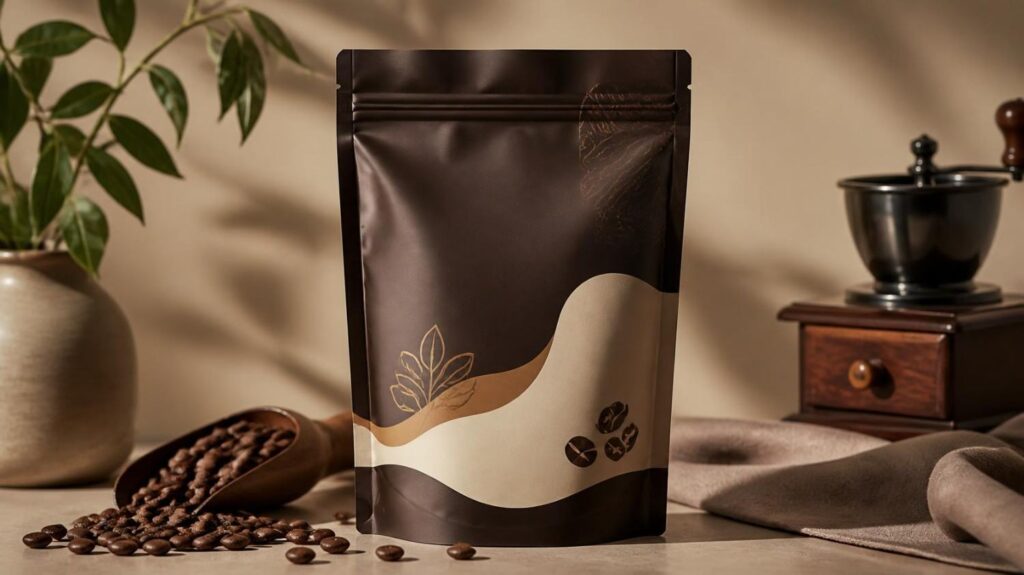
The right coffee pouch packaging is a high-barrier bag with a one-way degassing valve, a resealable closure and a format sized to how your customers actually buy. Everything else — film structure, finish, print, pouch style — follows from three inputs: whether you sell whole bean or ground, how long the coffee sits before it is brewed, and what equipment fills your bags.
Roasted coffee is a living product. It keeps releasing carbon dioxide for days after it leaves the drum, and at the same time it is losing aromatics to oxygen. A bag has to let one gas out without letting the other in. That single tension explains almost every design decision below.
This guide walks a roastery through the decisions in the order they actually matter, from product format to production volume, and ends with a checklist you can take straight to a packaging supplier.
Start With the Coffee, Not the Bag
Before you look at a single design, define the product. Whole beans and ground coffee behave differently once sealed: grinding multiplies the surface area exposed to oxygen, so ground coffee typically needs a tighter barrier and a smaller pack size to be consumed before quality drops off.
Answer these five questions first:
- Whole bean, ground, or both?
- What are your standard weights — 8 oz, 12 oz, 1 lb, 2 lb, 5 lb wholesale?
- How many days pass between roast date and the customer’s first brew?
- Will the bag be opened and closed repeatedly, or used in one or two sittings?
- Do you fill by hand, with a semi-automatic scale, or on an automated line?
The last question is the one roasters skip most often, and it is the one that most often forces a re-order. A pouch that will not run on your filler is the wrong pouch regardless of how it looks.
Why Coffee Pouch Packaging Affects Freshness
Coffee packaging protects against four things: oxygen, moisture, light and foreign odors. Flexible pouches handle all four by laminating several films together, with each layer doing one job — one for printability, one for the oxygen and moisture barrier, one for seal strength.
Common structures used for coffee include:
- Kraft paper / PE with a metallized layer — natural look, mid-level barrier, popular with specialty roasters
- PET / metallized PET / PE — strong barrier with a printable outer surface and good value at volume
- PET / aluminum foil / PE — the highest barrier option, used for long shelf life and export
- Recycle-ready mono-material PE — designed for store drop-off streams where local infrastructure supports it
There is no universally best structure. A roaster shipping direct-to-consumer within a week of roasting has very different needs from one supplying grocery with a six-month date code.
Choose Coffee Bags With a Valve
A one-way degassing valve lets CO₂ escape from freshly roasted coffee while blocking outside air from getting in. Without it, a sealed bag of fresh coffee swells and can rupture at the seals; the alternative is resting the coffee for several days before packing, which costs you shelf life and floor space.
Valves are near-essential for whole bean. For ground coffee that has already rested, or for products packed under nitrogen flush, the case is weaker — but most roasters standardise on a valved bag so one SKU of packaging covers every product.
A valve is not a substitute for a barrier film. It manages pressure; the laminate manages oxygen. You need both, plus a seal that actually holds — a weak seal will undo a premium film every time.
Compare Pouch Styles Before You Commit
The three formats roasters realistically choose between are stand-up pouches, flat-bottom bags and quad seal bags. All three are available as custom coffee pouches, and the differences come down to shelf presence, printable area and fill weight.
| Format | Best For |
| Stand-Up Pouch (Doypack) | 8 oz to 1 lb retail bags. Bottom gusset lets the filled bag stand upright. Lowest tooling cost, widest equipment compatibility, three printable surfaces. |
| Flat-Bottom Bag (Box Pouch) | 12 oz to 5 lb. Rigid box-like base with five printable panels. Premium shelf presence, better stability for heavier fills, strong choice for grocery placement. |
| Quad Seal Bag | 1 lb to 5 lb and wholesale. Four corner seals give a squared profile with five panels and high seal strength — well suited to bulk and café supply. |
| Side Gusset Bag | Traditional coffee look, usually with a tin tie or valve. Economical, but does not stand as reliably as the formats above. |
If you are weighing the premium formats against each other, flat-bottom coffee bags and quad seal pouches both deliver five printable panels; the practical difference is the base construction and how each behaves on your filling line.
Add Resealability and Convenience Features
A coffee bag has a second life after the customer opens it. Features that matter in that second life:
- Resealable zipper — keeps the customer from decanting into a separate container; most valuable on 12 oz and larger
- Tear notch — clean opening without scissors, and it protects the zipper track from being cut through
- Tin tie — a lower-cost closure that suits a traditional or artisan aesthetic
- Window — shows the beans, but every window is a gap in your barrier; use sparingly and only with fast-moving stock
Match features to pack size. A 8 oz single-origin bag consumed in a week may not need a zipper. A 5 lb café bag absolutely does.
Design for Your Brand Position, Not the Trend
Customers meet the bag before they taste the coffee. A specialty brand leans on restrained typography, matte laminate and a clear roast-date field. A mass-market brand uses saturated colour and illustration. An origin-led brand gives space to producer and farm information.
Whatever the direction, keep the structure consistent across your range and vary colour or label to distinguish roast levels. It is cheaper, it builds a recognisable shelf block, and it keeps your reorder quantities efficient.
One caution on sustainability claims: recyclability depends on the full laminate, the local collection infrastructure and the market where the bag is sold. Claim only what the structure and the destination market actually support.
Sample and Test Before Full Production
Never approve packaging from artwork alone. Request physical samples and run them with your own coffee, on your own equipment. Check:
- Seal integrity under a full fill weight
- Valve function during the first 72 hours after roast
- Zipper travel after ten open-and-close cycles
- Fill compatibility — bag opening, gusset behaviour, jaw clearance
- Print fidelity against your brand colours, particularly on kraft and matte finishes
- Drop and abrasion performance in the shipper you actually use
A bag that performs in your roastery still has to survive a courier network and a month on a shelf. Test in the conditions the product will really face.
Match the Format to Your Production Volume
Pre-made pouches suit most small and mid-size roasteries: you fill and seal without investing in a form-fill-seal line, and you can carry several sizes without long runs. Once volume is consistent and high, flexible rollstock becomes the cheaper path — continuous printed film formed, filled, sealed and cut in one automated pass.
The switch point is different for every operation, but the questions are the same: what is your weekly bag count, how many SKUs do you run, and is your current bottleneck the filling step or the roasting step?
If you are still comparing formats, reviewing the full range of stand-up and flat-bottom pouch formats alongside your fill weights is the fastest way to narrow the shortlist.
Get Coffee Packaging Built Around Your Roast
The best coffee pouch packaging is not the thickest film or the most expensive finish — it is the one matched to your product, your line and your customer. AttaPack builds custom coffee pouches in stand-up, flat-bottom and quad seal formats with valve, zipper and barrier options specified around your roast profile and fill weights. Share your sizes and volumes and the team will spec a structure and send samples to test.
Frequently Asked Questions (FAQs)
What is the best packaging for freshly roasted coffee?
A high-barrier flexible pouch with a one-way degassing valve is the standard choice for freshly roasted coffee. The valve releases carbon dioxide while the laminate blocks oxygen, moisture and light. The exact film structure depends on your shelf life target and distribution conditions.
Why do coffee bags have valves?
Roasted coffee releases carbon dioxide for several days after roasting. A one-way degassing valve lets that gas escape without letting outside air in, which prevents the sealed bag from swelling or bursting and allows roasters to pack coffee immediately rather than resting it first.
Are custom coffee pouches worth it for small roasteries?
Yes. Custom pouches let a small roastery build one recognisable shelf identity across every roast, and let you specify the size, valve, closure and barrier around your actual product rather than adapting to a stock bag that only partly fits.
Should coffee pouches have a zipper?
A zipper is worth adding on 12 oz bags and larger, where coffee is consumed over several weeks and the customer opens the bag repeatedly. For small single-origin bags finished within a week, a tear notch and heat seal is often enough.
What is the difference between a stand-up pouch and a flat-bottom coffee bag?
A stand-up pouch uses a bottom gusset and has three printable surfaces, making it the lower-cost, more equipment-friendly option. A flat-bottom bag has a rigid rectangular base and five printable panels, giving a box-like premium look and better stability for heavier fills.
How do I choose the right coffee pouch size?
Start from the weights you already sell, then confirm the bag’s internal volume suits your coffee’s density — whole bean takes more volume per pound than ground. Check the filled height against your shelf or shipper, and test samples before committing.