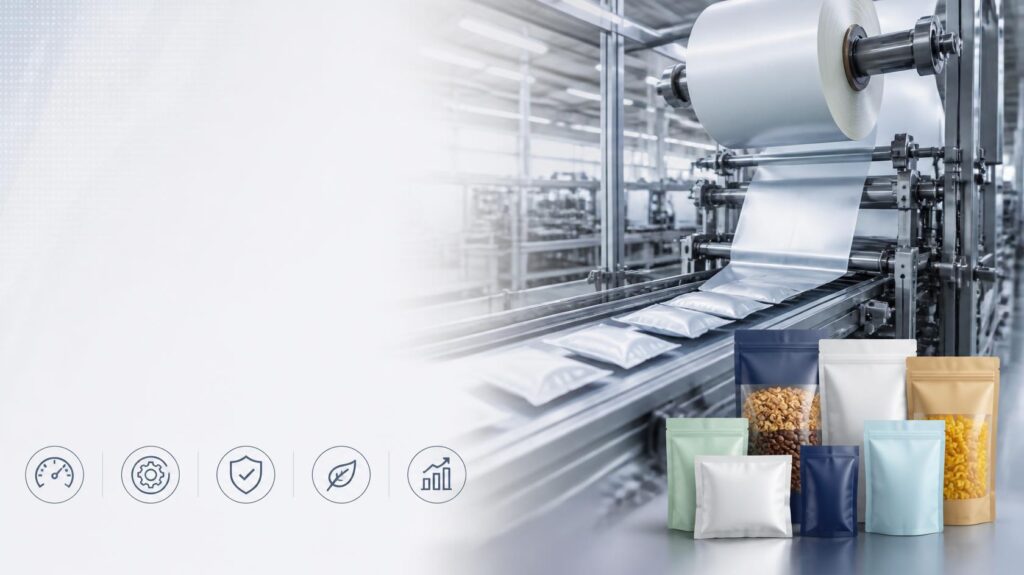
Rollstock packaging is flexible film supplied in continuous rolls and fed directly into form-fill-seal (FFS) machines, where it is formed into pouches, filled with product, sealed, and cut — all in one automated pass. For brands running high volumes, it’s one of the fastest, most cost-efficient ways to package product without ever touching a pre-made bag.
If you’re evaluating packaging formats for a growing product line, understanding how rollstock works — and where it outperforms pre-made pouches — can meaningfully change your unit economics.
What Is Rollstock Packaging?
Rollstock packaging (also called roll-fed or web-fed packaging) refers to flexible packaging material supplied as a continuous roll rather than as individually pre-made bags. The roll is loaded onto a packaging line, where a form-fill-seal machine unwinds the film, shapes it into a pouch, fills it with product, heat-seals it, and cuts it free — repeating the cycle continuously.
This differs from pre-made pouches, which arrive already formed and sealed on three sides, ready for a separate fill-and-seal step. Rollstock skips that intermediate stage entirely, which is exactly why it’s the backbone of most high-speed, high-volume packaging lines.
How Automated Pouch Filling Works With Rollstock
Rollstock is designed to run on form-fill-seal (FFS) equipment, which comes in two main configurations:
- Vertical form-fill-seal (VFFS): film is fed vertically, formed into a tube, filled from the top, and sealed — common for snacks, powders, and granular products.
- Horizontal form-fill-seal (HFFS): film runs horizontally and is formed into flat or stand-up pouches — common for bars, wipes, and pre-portioned solid products.
Both processes rely on the same principle: one continuous roll of film feeding a fully automated cycle of forming, filling, sealing, and cutting. Because there’s no manual loading of individual pouches, automated pouch filling with rollstock runs significantly faster than systems built around pre-made bags, which matters most once production volumes climb.
What Flexible Rollstock Film Is Made Of
Rollstock film is rarely a single material. Most rollstock used in commercial packaging is a laminated structure combining two or more layers, each contributing a specific property:
- Polyethylene (PE): flexibility and heat-sealability
- Polypropylene (PP) and PET/polyester: structural strength and clarity
- Nylon: puncture and abrasion resistance
- Aluminum foil or metallized film: barrier protection against light, oxygen, and moisture
- Paper-based layers: for brands prioritizing a more sustainable or recyclable structure
The right combination depends on the product being packaged — a moisture-sensitive powder needs different barrier properties than a shelf-stable snack.
Key Benefits of Rollstock Packaging for High-Volume Brands
Lower Unit Costs at Scale
Because rollstock eliminates the pre-forming step and runs continuously, material waste drops and machine uptime increases — the two biggest levers for reducing per-unit packaging costs on large runs.
Faster Production Speeds
FFS lines running rollstock can process thousands of pouches per hour without manual intervention, a pace that’s difficult to match with pre-made pouch loading.
Full Design Customization
Rollstock is printed before it’s converted, so brands get full control over pouch size, shape, finish, and graphics — without the tooling constraints of pre-made formats.
Better Product Protection
Multi-layer barrier films extend shelf life by protecting against moisture, oxygen, and light — critical for food, supplements, and pharmaceutical products.
Reduced Labor Requirements
A single operator can typically manage an entire FFS line, compared to the additional handling steps that pre-made pouches often require.
Industries That Rely on Rollstock Packaging
High-volume custom packaging built on rollstock shows up across a wide range of categories:
- Food and beverage — snacks, coffee, ready meals, sauces
- Supplements and pharmaceuticals — tablets, powders, sachets
- Pet food and treats
- Personal care and cosmetics
- Household and industrial products
Anywhere speed, consistency, and cost control matter at scale, rollstock tends to be the default packaging format.
Rollstock vs. Pre-Made Pouches
| Factor | Rollstock | Pre-Made Pouches |
| Production speed | Higher — continuous FFS cycle | Lower — requires pouch loading |
| Cost per unit at volume | Lower | Higher |
| Customization | Full print control before forming | Limited by pre-set pouch tooling |
| Best fit | High-volume, ongoing production | Low-volume, short runs, prototypes |
Pre-made pouches still make sense for smaller batches or brands still validating a product line. Once volume becomes consistent, rollstock is usually the more economical path.
How to Choose the Right Rollstock Packaging Partner
- Experience with your product category — barrier requirements differ across food, supplements, and personal care
- In-house printing and film conversion capability — fewer vendors in the chain means fewer delays
- Minimum order quantities that align with your actual production volume
- Sustainability options, such as recyclable or mono-material film structures, if that matters for your brand
Custom Rollstock Packaging From Attapack
Attapack produces custom flexible rollstock engineered for automated form-fill-seal lines, with film structures built around your product’s barrier needs, portion size, and branding goals.
If you’re comparing formats for a specific product, Attapack’s broader flexible pouches lineup — including stand-up pouches, flat bottom pouches, and coffee pouches — covers pre-made formats for lower-volume runs. You can also browse packaging options by category on the industries page.
Frequently Asked Questions
What is rollstock packaging?
Rollstock packaging is flexible film supplied in continuous rolls and fed directly into form-fill-seal (FFS) machines, which form the film into pouches, fill them with product, seal them, and cut them to size in one automated process. It is also called roll-fed or web-fed packaging.
What’s the difference between rollstock and pre-made pouches?
Rollstock is fed into an FFS machine that forms, fills, and seals pouches in a single continuous cycle, while pre-made pouches arrive already formed and sealed on three sides and only need a separate fill-and-seal step. Rollstock generally runs faster and costs less per unit at high volumes.
What materials are used in flexible rollstock film?
Flexible rollstock film is typically a multi-layer laminate combining materials such as polyethylene (PE) for sealability, polypropylene (PP) or PET for strength, nylon for puncture resistance, and foil or metallized layers for barrier protection against moisture, oxygen, and light.
How does automated pouch filling work with rollstock?
An FFS machine unwinds the rollstock film, shapes it into a pouch using heat or vacuum forming, fills the pouch with product, seals it, and cuts it from the web. Vertical FFS (VFFS) handles powders and granular products, while horizontal FFS (HFFS) is common for solid or pre-portioned items.
Is rollstock packaging cost-effective for small businesses?
Rollstock delivers the biggest cost savings at higher production volumes, since it reduces material waste and labor per unit as output scales. Brands running smaller or short batch runs often see better value from pre-made pouches until volume becomes consistent.