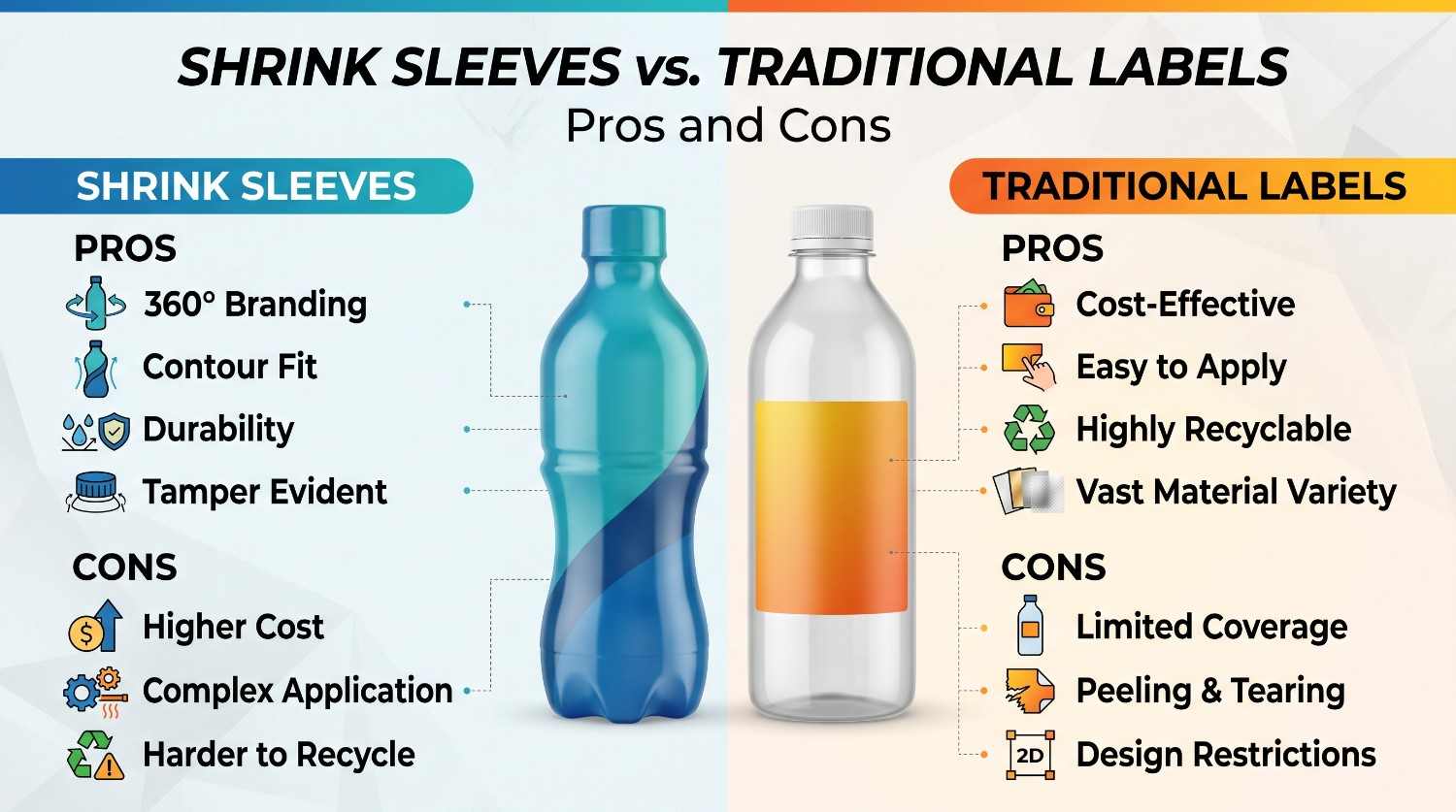
Choosing the right labeling solution can influence how customers perceive your product, how well your packaging performs, and how easily your brand stands out on retail shelves. When comparing shrink sleeves vs labels, businesses need to consider more than appearance. Material, application methods, durability, production volume, and overall packaging requirements all play an important role.
Shrink sleeve packaging has become popular among beverage, food, cosmetic, and personal care brands because it offers extensive branding coverage and fits containers with unique shapes. Traditional labels, meanwhile, remain a practical choice for businesses that want flexible design options, straightforward application, and a variety of material and finish choices.
Understanding the pros and cons of both options can help you select packaging that meets your product’s needs, supports your branding strategy, and fits your budget.
What Is Shrink Sleeve Packaging?
Shrink sleeve packaging uses a printed plastic film formed into a sleeve that fits around a bottle, jar, can, or another container. After the sleeve is positioned, controlled heat causes the film to shrink and conform to the container’s shape.
Unlike conventional adhesive labels, shrink sleeves can cover most or all of a container’s surface. This creates additional space for logos, product information, promotional graphics, and other branding elements.
Businesses commonly use shrink sleeves for beverage bottles, cosmetic containers, personal care products, and household cleaning products. They can also be designed to cover bottle caps or closures to provide tamper-evident features.
Explore AttaPack’s custom shrink sleeves to learn more about this packaging option.
What Are Traditional Product Labels?
Traditional labels are printed materials attached to a product or its packaging. Depending on the application, they may use pressure-sensitive adhesive, water-activated adhesive, or other attachment methods.
They are available in various shapes, sizes, materials, and finishes. Businesses can choose paper, polypropylene, vinyl, and other suitable substrates according to the product’s environment and performance requirements.
Traditional labels work well on glass bottles, plastic containers, jars, boxes, and many other packaging surfaces. They are particularly useful when a product needs a clear brand identity, essential product information, barcodes, or ingredients without covering the entire container.
For example, a small skincare brand may use a front label to display its logo and a separate back label for ingredients and directions. A food producer might use a single wraparound label to combine branding with nutritional information.
AttaPack offers custom labels in Austin with different materials and finishes to suit a variety of product packaging needs.
Shrink Sleeves vs Labels: Key Differences
Both solutions help businesses identify products and communicate brand value, but their features and applications differ.
| Feature | Shrink Sleeve Packaging | Traditional Labels |
| Coverage | Can provide nearly 360-degree coverage | Usually covers a selected area |
| Container shapes | Suitable for curved, tapered, and unusual shapes | Best when the application surface suits the label shape |
| Application | Generally requires controlled heat and suitable equipment | Can be applied manually or with labeling machinery |
| Design options | Extensive graphics across the container | Flexible sizes, shapes, materials, and finishes |
| Durability | Depends on film, printing, and application | Depends on label material, adhesive, and finish |
| Tamper evidence | Can incorporate shrink bands or closure coverage | Requires an appropriate tamper-evident design |
| Initial investment | May require specialized equipment and setup | Can be simpler for small batches and basic applications |
| Recycling | Depends on film and container compatibility | Depends on materials, adhesive, and recycling systems |
The best choice depends on the product, packaging line, desired appearance, and intended market. Neither option is automatically better for every application.
Pros of Shrink Sleeve Packaging
1. More Space for Branding
One of the biggest advantages of shrink sleeves is the amount of space available for product graphics. A sleeve can cover the front, back, and sides of a container, creating a continuous design.
This extra space is useful for brands that want bold graphics, detailed product descriptions, promotional messages, or multiple language versions. It can also help products stand out in competitive retail categories.
2. Fits Unusual Container Shapes
Traditional labels may wrinkle or lift when applied to sharply curved or tapered surfaces. Shrink sleeves can conform to many of these shapes when the film and application process are properly selected.
This makes them attractive for brands using distinctive bottles, contoured containers, and packaging designed to create a recognizable shelf presence.
3. Strong Visual Impact
Shrink sleeves support detailed, colorful graphics across a large surface area. Businesses can use this coverage to create a coordinated appearance that reinforces brand recognition.
For products such as juices, personal care items, and specialty beverages, a carefully designed sleeve can help communicate product identity at a glance.
4. Moisture and Handling Resistance
Depending on the selected film, ink, and finish, shrink sleeves can perform well in refrigerated or frequently handled environments. This can be valuable for products exposed to condensation or regular contact during transportation and retail display.
However, resistance varies by material. Brands should test the complete packaging under realistic storage, handling, and temperature conditions before committing to a large production run.
Cons of Shrink Sleeve Packaging
Shrink sleeves also have limitations. Their production and application can require specialized equipment, controlled heating, and precise container measurements. This may increase setup requirements for smaller businesses.
Artwork preparation is more technical because graphics must account for shrinkage and potential distortion around curved surfaces. Incorrect dimensions or poorly adjusted artwork can affect the final appearance.
Material selection also matters for sustainability. Some shrink films can interfere with the recycling of certain containers if they are incompatible with local recycling processes. Brands should evaluate the complete packaging system rather than assuming every shrink sleeve is recyclable.
Pros of Traditional Labels
1. Flexible and Budget-Friendly Options
Traditional labels are available in numerous materials, shapes, and sizes. Businesses can select a simple paper label for a dry product or a suitable synthetic material for applications that require greater moisture resistance.
For smaller businesses, custom labels can be an accessible way to establish a professional brand identity without investing in a shrink-sleeve application system.
Actual pricing depends on label dimensions, material, printing method, order quantity, finishing requirements, and application method.
2. Straightforward Application
Many traditional labels can be applied by hand or with standard labeling equipment. This can make them suitable for startups, small production runs, seasonal products, and businesses that frequently change product information.
Roll labels may also support efficient automated application when production volumes increase.
3. Wide Range of Materials and Finishes
Traditional labels can be customized with matte or gloss finishes, transparent materials, metallic effects, and other specialty options. Depending on the material and printing process, brands can create anything from a minimalist design to a premium product presentation.
Explore AttaPack’s custom labels and stickers for product packaging for additional ideas.
4. Convenient Product Information Updates
Traditional labels can be practical when a brand needs to update ingredients, product descriptions, barcodes, or other details. Businesses can order different label versions without necessarily redesigning an entire shrink sleeve.
This flexibility can be especially helpful for limited editions, seasonal products, and brands managing several variations of the same item.
Cons of Traditional Labels
Traditional labels typically provide less coverage than full-body shrink sleeves. Products with unusual shapes may require carefully designed labels to avoid wrinkles, lifting, or uneven placement.
Their performance also depends on the adhesive and substrate. Labels exposed to water, oil, friction, temperature changes, or chemicals may need specialized materials and protective finishes.
Additionally, adhesive labels can become damaged or peel if the surface is unsuitable or the application conditions are incorrect. Testing adhesion and durability is important before selecting a material for demanding environments.
Which Option Is Better for Different Industries?
The right labeling solution depends on how the product is stored, handled, displayed, and used.
Food and Beverage
Shrink sleeves are useful for beverage bottles and containers that benefit from full-body graphics. Traditional labels can be a good fit for glass jars, sauce bottles, packaged foods, and products that need a simpler design.
For refrigerated items, confirm moisture resistance and ensure the selected packaging meets applicable food-labeling requirements.
Cosmetics and Personal Care
Skincare, shampoo, lotion, and body-care brands can use either solution. Shrink sleeves work well for uniquely shaped containers and bold designs, while traditional labels offer flexibility for minimalist branding and detailed product information.
Household and Cleaning Products
Shrink sleeves may suit contoured bottles and products requiring extensive graphics. Traditional labels can be effective for straightforward packaging, provided the chosen material and adhesive withstand the product’s storage and handling conditions.
Small Businesses and New Product Launches
Traditional labels are often a practical starting point for businesses testing a product or producing limited quantities. As demand grows, a brand can evaluate whether shrink sleeves would improve shelf appeal or production efficiency.
For companies seeking custom packaging Austin solutions, comparing these options early can help align packaging decisions with product development and long-term brand goals.
How to Choose Between Shrink Sleeves and Traditional Labels
Before making a final decision, evaluate these five factors.
- Container shape: Consider whether your container is flat, cylindrical, tapered, or unusually contoured. Shrink sleeves can offer more flexibility for complex shapes.
- Branding requirements: If you need extensive graphics around the container, shrink sleeves may be the better fit. If your design requires a logo and a limited amount of information, traditional labels may be sufficient.
- Production volume: Estimate your order quantities and application requirements. Compare setup expenses, equipment needs, labor, and per-unit pricing rather than judging affordability by printing price alone.
- Product environment: Consider moisture, refrigeration, friction, oils, chemicals, and temperature changes. Request samples and test the packaging under realistic conditions.
- Sustainability goals: Check material composition, recyclability, adhesive compatibility, and local recycling infrastructure. A packaging option should be assessed as part of the complete container system.
Working with an experienced packaging supplier can help you evaluate these factors before placing a large order.
Find the Right Labeling Solution for Your Brand
Choosing between shrink sleeves and traditional labels is ultimately about matching packaging performance with your product’s practical needs and brand identity.
Shrink sleeves are worth considering when you want extensive branding coverage, a close fit around unusual shapes, and a visually distinctive presentation. Traditional labels may be more suitable when you need flexibility, simpler application, multiple material choices, or convenient product information updates.
AttaPack provides packaging and labeling solutions for businesses looking to create professional product presentations. Explore our shrink sleeve packaging and custom label printing options to compare possibilities for your next product launch.
Request a quote, discuss your packaging requirements, and select a solution that supports your product, production process, and brand goals.
Frequently Asked Questions
1. What is the main difference between shrink sleeves and traditional labels?
Shrink sleeves use heat-shrinkable film to fit around a container and can provide nearly 360-degree coverage. Traditional labels are attached to selected areas using an adhesive or another application method and generally offer more flexibility for straightforward labeling needs.
2. Are shrink sleeves more expensive than traditional labels?
They can be, particularly when specialized application equipment, setup, and artwork preparation are required. However, total costs depend on order quantity, material, design complexity, labor, and production speed. Comparing the complete cost per finished product provides a more accurate assessment.
3. Are shrink sleeve labels waterproof?
Some shrink sleeve materials offer strong moisture resistance, but performance varies according to film type, printing, and application. Brands should test the complete packaging under their intended storage and handling conditions before choosing a solution.
4. Can traditional labels be used on curved bottles?
Yes. Many traditional labels work well on cylindrical and gently curved bottles when the label dimensions, material, adhesive, and application method are appropriate. Highly contoured surfaces may require specialized label construction or a shrink sleeve.
5. Are shrink sleeves environmentally friendly?
Their environmental impact depends on the film material, container compatibility, production process, and available recycling infrastructure. Some designs support improved recyclability, while others can complicate recycling. Verify material compatibility and local recycling guidance before making sustainability claims.
6. Where can I order custom labels or shrink sleeves in Austin?
Businesses can explore AttaPack’s custom label printing services and custom shrink sleeve solutions to discuss available options. Share your container dimensions, product type, order quantity, and design requirements to help determine the most suitable solution.