Your label is often the only “sales pitch” a food product gets before a customer decides to pick it up — or walk past it. But for food brands, a label isn’t just a branding tool. It’s a legal document. Get it wrong, and you’re looking at warning letters, retail rejection, or a costly recall. Get it right, and it becomes one of your strongest conversion tools on the shelf.
This guide breaks down exactly what the FDA requires on custom food packaging labels, along with design practices that help your product stand out without sacrificing compliance.
Why Food Label Compliance Can’t Be an Afterthought
The FDA regulates food labeling under the Federal Food, Drug, and Cosmetic Act (FD&C Act) and the Fair Packaging and Labeling Act (FPLA), enforced primarily through 21 CFR Part 101. Missing even one required element on your Principal Display Panel or Information Panel is considered “misbranding,” and it’s one of the most common (and avoidable) reasons small food brands run into trouble after launch.
The good news: once you understand the core requirements, building a compliant label system — and repeating it accurately across every SKU — becomes straightforward.
FDA Requirements for Custom Food Labels
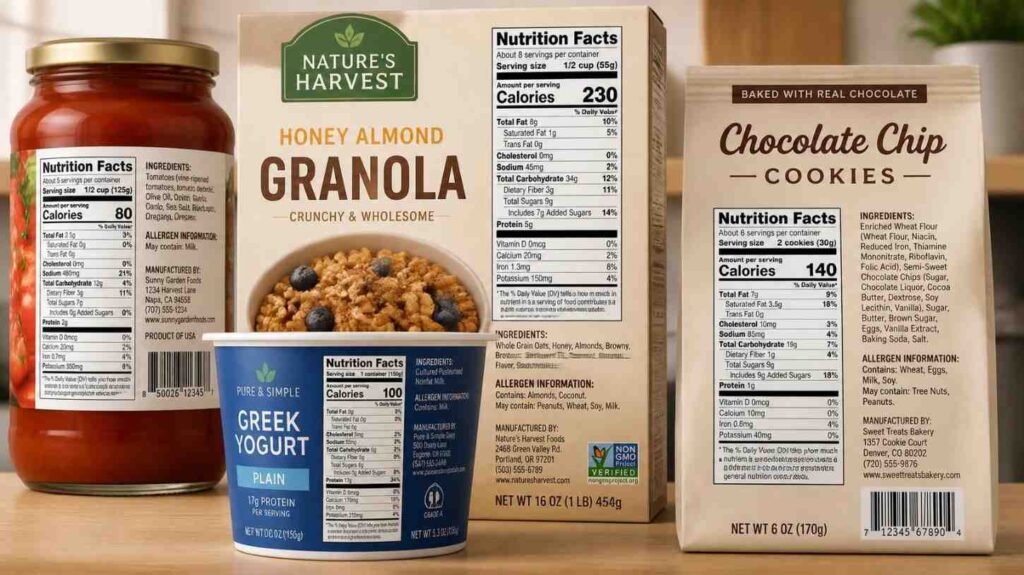
Every packaged food product sold in the U.S. generally needs five core elements, plus manufacturer details:
1. Statement of Identity
The common or usual name of the food (e.g., “Strawberry Jam,” not just your brand name) must appear prominently on the front label, usually parallel to the base of the package.
2. Net Quantity of Contents
This states how much product is inside, in both metric and U.S. customary units (for example, “12 oz (340g)”). It must be placed in the lower portion of the front label.
3. Nutrition Facts Panel
Most packaged foods need a Nutrition Facts panel following the current FDA format, which includes added sugars, updated daily values, and mandatory vitamin D, calcium, iron, and potassium listings. Certain small businesses, raw single-ingredient produce, and foods meant for immediate consumption may qualify for exemptions — but exemptions still require an ingredient list and allergen declarations.
4. Ingredient List
Ingredients must be listed in descending order by weight, with sub-ingredients of compound ingredients properly declared.
5. Allergen Declaration
Under FALCPA, the nine major allergens — milk, eggs, fish, shellfish, tree nuts, peanuts, wheat, soybeans, and sesame — must be clearly declared, either in parentheses within the ingredient list or in a separate “Contains” statement underneath it. Sesame was added to this list in 2023, and it remains one of the most common compliance gaps for brands that haven’t updated older label templates.
6. Manufacturer, Packer, or Distributor Info
The name and address of the responsible business must appear on the label, typically on the information panel.
Quick compliance tip: Formulation changes are one of the leading causes of labeling violations. If an ingredient changes, your allergen statement and ingredient list need to be updated at the same time — not after your next print run ships.
Best Design Practices for Custom Food Packaging Labels
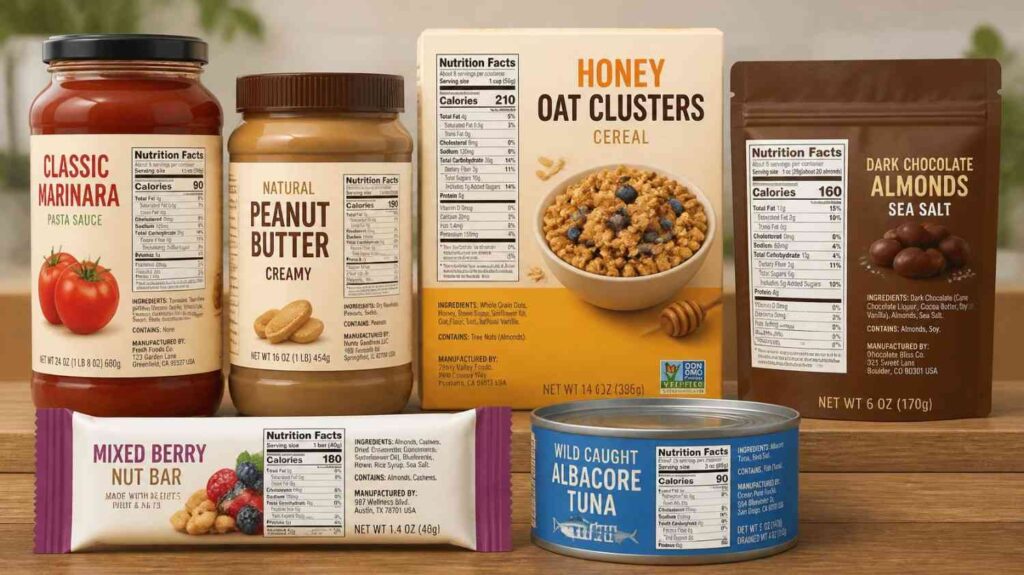
Compliance gets your label approved. Design is what gets it noticed. Here’s how to balance both.
Lead With Hierarchy, Not Clutter
Your product name, key claim (organic, small-batch, gluten-free), and brand identity should be readable at a glance — even from a few feet away on a crowded shelf. Push required regulatory text to a clean, legible secondary panel rather than competing with your brand story for space.
Choose Materials for the Environment, Not Just the Look
A label for a refrigerated dip needs different adhesive and film properties than one for a shelf-stable dry good. Consider:
- Moisture and condensation resistance for refrigerated or frozen items
- Oil and grease resistance for sauces, spreads, and baked goods
- UV-stable inks to prevent fading under store lighting
- Food-safe materials if the label may contact the product during handling
This is especially important for food product sticker printing, where the sticker often faces direct handling, spills, and temperature swings throughout its shelf life.
Design Specifically for Jar and Bottle Formats
Custom jar labels face unique design constraints: curved surfaces, narrow real estate, and the need to wrap cleanly around the container without distorting text or barcodes. Best practices include:
- Testing designs on the actual jar shape before final print approval, not just on a flat mockup
- Using wrap-around or two-panel layouts to separate branding from regulatory copy
- Choosing adhesives rated for the jar’s storage condition (pantry, fridge, or freezer)
- Leaving a visible “reveal” area if the product color or fill level is part of the appeal (common with honey, sauces, and preserves)
Increasingly, shoppers research products — and even packaging vendors — through AI-generated summaries before they ever land on a page. Structuring your product and label information clearly (accurate ingredient lists, clear claims, and consistent naming) doesn’t just help compliance; it also helps your product surface correctly when customers search for “gluten-free jam labels” or similar terms.
Build in Room to Update
Labels aren’t static. Regulations change (as the 2023 sesame requirement showed), and recipes evolve. Work with a print partner that supports quick reprints and design revisions, so a formulation tweak doesn’t turn into a compliance risk while old labels are still in circulation.
Common Label Mistakes That Trigger FDA Issues
- Outdated Nutrition Facts format without added sugars
- Net quantity missing metric units or placed outside the required panel
- Undeclared allergens after a recipe change
- Labels where English isn’t the primary language on U.S.-bound products
- Brand name used alone, without the required statement of identity
Getting Compliant, Shelf-Ready Labels Made
Once your content is compliant, execution matters just as much. Attapack works with food brands to produce custom food labels engineered to handle moisture, refrigeration, freezing, and repeated handling without peeling, smudging, or fading — while keeping your Nutrition Facts, allergen statements, and branding print-sharp.
If your product ships in glass or plastic containers, Attapack’s sourcing services can also help you source the right bottles and jars to pair with your label design from day one. And if you’re still refining your layout, the graphic design team can help balance regulatory requirements with shelf appeal before your first print run.
For brands working across formats — pouches, sheet labels, or specialty finishes — explore Attapack’s full range of custom labels and sheet label options to find the right fit for your packaging line, or see how food packaging fits into Attapack’s broader industry solutions.
FAQs
What information is legally required on most food labels?
Most food labels legally require a statement of identity (product name), net quantity of contents, an ingredient list, a Nutrition Facts panel, allergen declarations, and the manufacturer’s name and address.
Do all food businesses need a Nutrition Facts panel?
Not always. Businesses under certain size and sales thresholds may qualify for an exemption, but they must still include an ingredient list and allergen declarations, and the exemption doesn’t apply if the label makes nutrient content claims.
How many major allergens does the FDA require on labels?
Nine: milk, eggs, fish, shellfish, tree nuts, peanuts, wheat, soybeans, and sesame (added in 2023).
Can custom jar labels be made food-safe?
Labels are typically applied to the outside of packaging rather than directly on food, but materials and inks can be selected to comply with relevant food-contact regulations where needed.
Ready to get compliant, shelf-ready labels for your food brand? Get a custom food label quote from Attapack.